
Last updated: September 17, 2026
Introduction to Seerist
Seerist is a threat and risk intelligence company that helps organizations monitor and anticipate geopolitical, security, and operational risks worldwide. Its content focuses on global threats, risks, and operational intelligence.
Seerist Methodology
Seerist uses AI and machine learning to continuously scan and analyze large volumes of global open-source data for indicators of geopolitical, security, operational, and societal risk. Potential events are validated and contextualized by human analysts, who assess severity, credibility, and likely impact before alerts are issued. Risk levels are determined based on factors such as severity, likelihood, geographic proximity, stability trends, and potential operational impact.
Seerist Content
Seerist provides Safeture with a variety of content types, including:
-
Alerts
-
Country Information
-
City Information
-
Country Risk Assessment
Seerist Alerts
Seerist has three types of events/alerts: Breaking, Verified, and Future. Each type has its own risk categories and sub-categories. While the event types reflect differences in how incidents are identified, validated, and timed, they are not distinguished for end users in the Safeture platform and are presented simply as alerts.
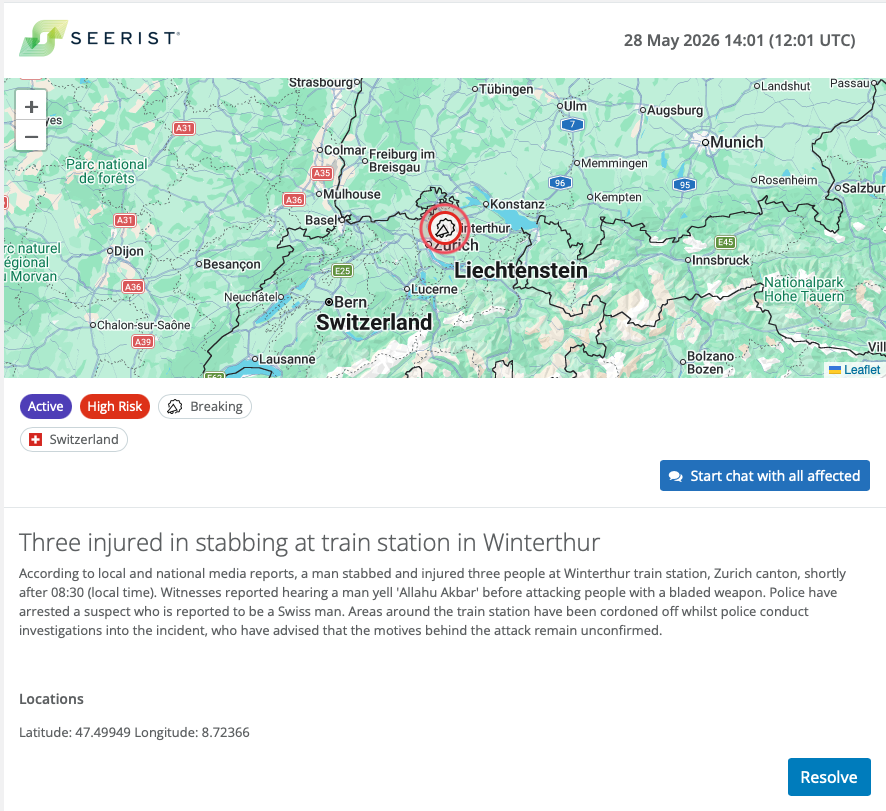
Breaking events
Breaking events are issued by Seerist's dedicated intelligence team for events or developments in a location that both:
-
Have the potential for immediate implications for physical security or operational continuity, and
-
Diverge from the baseline security, operational or political environment in that location, such that the event is assessed to be anomalous.
Seerist's intelligence team reports Breaking Events as soon as they are detected — even if the information does not yet meet the standard for verification. As details emerge, Seerist updates the report and indicates when reporting is closed. Where the category matches the verified-events methodology (crime, terrorism, unrest, war), Seerist will also issue a corresponding Verified Event.
Breaking Event coverage focuses on major cities, particularly business and commercial centres and transport hubs, with an emphasis on security, weather, unrest, and transport/flight disruptions (including airport closures). The threshold for reporting a Breaking Event is intentionally high, prioritizing the most impactful incidents for a given location. Reporting thresholds are generally higher in countries with HIGH or EXTREME security risk ratings.
Information included:
-
Date
-
Description (location information, time of incident, casualty figures or damage caused if known, and any notable disruption)
-
Country
-
Category/subcategory
-
Latitude/longitude
-
Location precision
-
Source
Breaking events currently use "Breaking" as their main category.
Risk level: Breaking events are always High risk.
Verified events
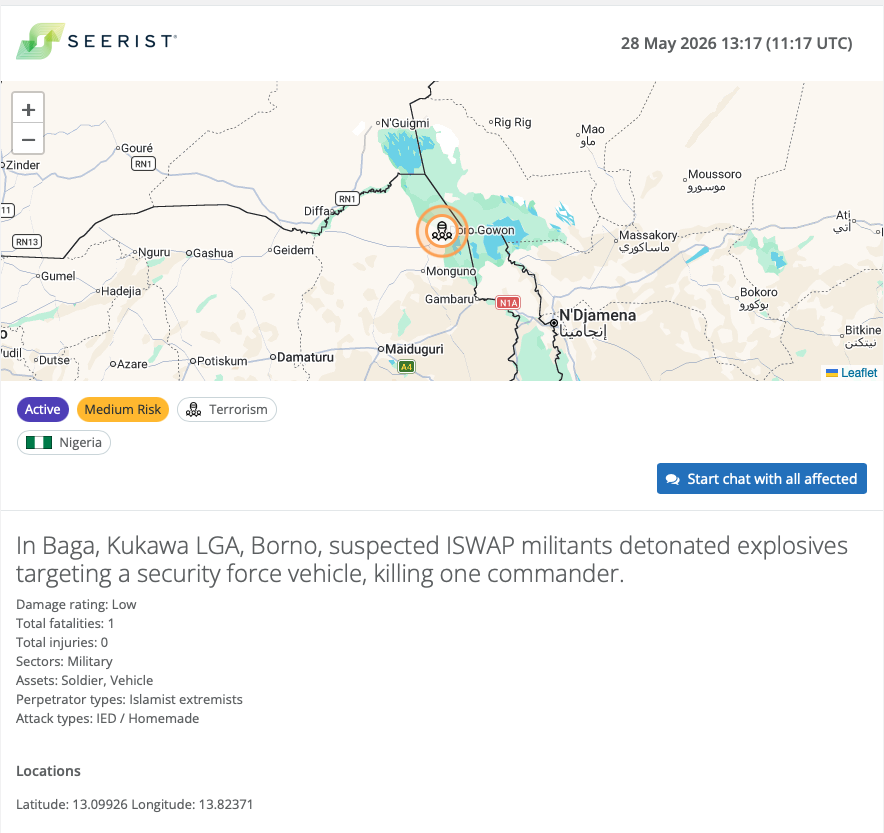
Verified events cover verified incidents of war, terrorism, unrest and violent crime, with a focus on organized crime and violent crime relevant to a business audience. The database records events from 2016 and is designed to provide historical context for these threats in specific locations, and to support trend analysis over time.
The verified events database is maintained by Seerist's global team of intelligence researchers, based in Singapore, Delhi, London, Johannesburg, Washington DC, and Mexico City.
Information included:
-
Date
-
Location: latitude/longitude, location precision, country (including a secondary country for bilateral events, e.g. cross-border skirmishes)
-
Description
-
Main category
-
Target: sector and asset type (the specific type of physical asset or individual affected, e.g. hotel, mine site, school)
-
Attack type: the weapon or method used
-
Perpetrator: the specific group involved and/or general ideological affinity, where known
-
Severity: scored on a 1–10 scale
Severity scoring
Scores are attributed by researchers based on available information. The 1–10 scale is translated into Safeture’s Low/Medium/High rating:
|
Seerist severity score |
Safeture’s risk level mapping |
|---|---|
|
1–2 |
Low |
|
3–4 |
Medium |
|
5–10 |
High |
Maritime events: A subset of verified events, collected by Control Risks' specialist team of maritime security experts using both open and closed sources, with additional data fields relevant to the maritime domain.
Future events
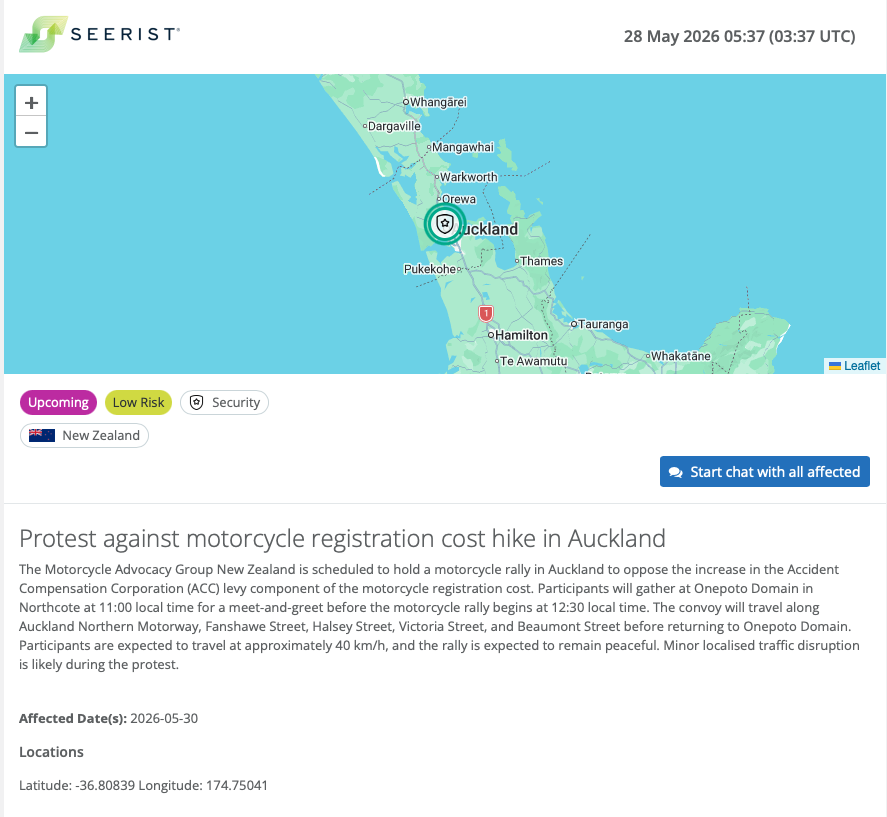
Future events cover upcoming events that may present potential security or operational risks, such as planned protests, demonstrations, strikes, and other anticipated disruptions. They are only recorded in categories where information is available ahead of time.
Main categories: Unrest, Holiday, Sporting/Cultural/Other, Political, Conflict/Military, Geopolitical, Disaster
Sub-categories: Protests/Riots, Strikes/Labor Unrest, Election, Military Activity, Bilateral Meeting, Multilateral Meeting
Risk level: Future events are rated Low, Medium, or High.
Seerist Country Information
Seerist's country information is organized under the following tabs:
-
Overview
-
Risk
-
Alerts
-
Cities Report
Overview: A political and historical overview, including an executive and legislative summary, as well as key security-related issues.
Risk: A summary of the country's risk assessment, including an overall risk level and detailed assessments across the following categories, each with its own assigned risk level:
-
Operational
-
Political
-
Security
-
Maritime (where applicable)
The Security risk level serves as the overall country risk level.
Note: Some subcategories may carry a higher risk level than the headline country rating in relevant countries.
Alerts: An alert feed showing the most recent alerts affecting that country.
Cities Report: A high-level guide to security and other issues that may affect visitors to a major city or cities, including recommendations and considerations for specific traveller groups, and arrival information. Key issues identified for business travelers include political, stability, operational, security, and inclusivity issues. The arrival section covers issues a visitor may face when arriving or travelling around a city.
Seerist Country Risk Assessments
Country Risk is assessed across four categories, each assigned its own risk level:
-
Operational
-
Political
-
Security
-
Maritime (when applicable)
The Security risk level also serves as the overall country risk level. This overall rating is displayed on the Security Overview map and in the Risk tab within Seerist's Country Information.
Operational Risk
Evaluates the influence of societal and structural factors either facilitating or impeding efficient business operations. Factors assessed include infrastructure; ease of establishing and maintaining a functioning business; ease of recruiting and retaining skilled workers; and bureaucratic and business culture. Operational risk may vary for companies and investment projects due to factors such as industry sector, investor nationality, and geographic location.
-
Very Low: The environment for business is favourable.
-
Low: The environment is broadly positive with occasional challenges that do not significantly impede business.
-
Medium: Business faces regular operational difficulties; occasionally these may be serious.
-
High: The operating environment presents persistent and serious challenges for business.
-
Extreme: Operating conditions present sustained critical risks to business.
Sub-category — Infrastructure Risk: Evaluates the extent to which transport, power, water and communications networks facilitate or impede business operations. Factors assessed include availability and quality of infrastructure; government commitment and ability to maintain/improve it; and constraints on development (finances, geography, land rights, pressure groups).
Sub-category — Institutional Risk: Evaluates the impact on business of the quality, efficiency and effectiveness of government administration and the judiciary. Factors assessed include cost/complexity of regulatory compliance; prevalence of regulatory bottlenecks; ease of obtaining licences, permits, visas, and other documentation; and judicial efficiency and independence.
Political Risk
Evaluates the likelihood of government interference and political instability, and their impact on the business environment. Assesses general political stability and policy issues such as regulatory change, high-level corruption, reputational risk, expropriation and nationalisation, contractual interference, sovereign default and non-payment, and international sanctions.
Political risk evaluates the likelihood of government interference and political instability, and their impact on the business environment. Political risk assesses general political stability and policy issues such as regulatory change, high-level corruption, reputational risk, expropriation and nationalisation, contractual interference, sovereign default and non-payment, and international sanctions. While the rating applies generally to the designated jurisdiction, political risk may vary considerably between industry sectors and investor nationalities.
Very Low: The political and policy environments are favourable for business
Low: The political and policy environments are broadly favourable for business
Medium: The political and policy environments are periodically challenging for business
High: The political and policy environments are persistently challenging for business
Extreme: The political and policy environments present sustained critical challenges to business
Political stability risk (sub-category)
Political stability risk evaluates the impact of political instability on business operations. It assesses the likelihood of the government completing its expected or appointed term; levels of political polarisation; the threat of unconstitutional change of government; the role and influence of non- government political actors; and the degree of political repression.
Regulatory risk (sub-category)
Regulatory risk evaluates the development, implementation, stability and enforcement of regulation that impacts the business environment. Factors assessed include the stability of the regulatory environment and potential for abrupt regulatory change; the transparency and openness of the process for developing regulation; the influence of vested or special interests over regulation; the independence of regulatory agencies; and patterns of regulatory enforcement, including selective enforcement for political or other reasons.
Contract risk (sub-category)
Contract risk evaluates the predictability, durability, legality and legitimacy of commercial contracts signed in the jurisdiction, especially between foreign companies and the government or state-owned entities. It addresses the likelihood that a government will interfere in a contract; the likelihood that political circumstances will call into question the legality and legitimacy of contracts; the likelihood of non-payment; and the likelihood that the government will review and potentially cancel or revise operating or ownership licences granted to companies.
Integrity risk (sub-category)
Integrity risk evaluates the ability of companies to operate in compliance with international norms, responsible business practices and corporate ethical standards. It encompasses the prevalence and threat of corruption to routine and legitimate business activities; the nature and enforcement of anti-corruption policy; the transparency and fairness of contract and licence awards; the availability, accessibility and transparency of corporate records; and the nature and severity of human rights, environmental and other reputational concerns.
Sovereign risk (sub-category)
Sovereign risk evaluates the willingness and ability of the central government to pay its debts. Factors assessed include government ideology and policy regarding debt; attitude towards bondholders and debt holdouts; general political stability; access to international capital markets; the level and profile of government debt; and vulnerability to external shocks and financial contagion.
Security Risk
Evaluates threats to the financial, physical and human assets of a company, as well as the willingness and capability of public security forces to protect corporate assets and personnel. Factors assessed include military conflict, insurgency, terrorist attacks, strikes and riots, vandalism, kidnapping, and violent and acquisitive crime.
Security risk evaluates threats to the financial, physical and human assets of a company, as well as the willingness and capability of public security forces to protect corporate assets and personnel. Factors assessed include military conflict, insurgency, terrorist attacks, strikes and riots, vandalism, kidnapping, and violent and acquisitive crime. Security risk may vary for companies and investment projects because of factors such as industry sector, investor nationality and geographic location.
Very Low: The security environment for business is favourable
Low: Security conditions do not impede normal business
Medium: Security conditions sometimes impede business operations; routine business activities may sometimes require enhanced security provision
High: The security environment presents persistent and serious challenges for business; routine business activities generally require enhanced or specialised security provision
Extreme: Security conditions pose sustained critical risks to business; companies require significantly enhanced security provision to operate
Crime risk (sub-category)
Crime risk evaluates the threat to business assets and personnel from offences against property and offences against the person. Factors assessed include levels and types of acquisitive, violent and organised crime, and the authorities' ability to counter crime threats.
Terrorism risk (sub-category)
Terrorism risk evaluates the capability and intent of groups and individuals to carry out acts of terrorism that may impact business operations. Factors assessed include intent to attack targets inside the country; the operational capabilities and likely target preferences of threat groups; and the ability of the authorities and security forces to counter terrorist threats. Terrorism risk may vary for companies and investment projects because of factors such as industry sector, investor nationality and geographic location.
Control Risks defines 'terrorism' as the calculated use of violence by non-state actors against state or civilian targets to advance an ideological cause by influencing a wider audience through intimidation. Terrorist acts include bombings, shootings, assassinations, hostage-taking, improvised or opportunistic attacks, and attacks using unconventional weapons.
War risk (sub-category)
War risk assesses the likelihood of state or organised non-state actors using force directly or indirectly and affecting business operations. Factors assessed include the likelihood of inter-state war, civil war, revolution, rebellion, insurrection, insurgency, sabotage and state-sponsored operations, coup d'état, mutiny and counter-terrorism operations, and the associated potential for property damage, death and injury, and disruption to operations resulting from damage or denial of access to vital infrastructure.
Civil unrest risk (sub-category)
Civil unrest risk evaluates the likelihood of non-violent or violent mass actions by non-state actors disrupting routine social, government and business operations, as well as the severity of resultant damage or loss. Factors assessed include political, economic, labour, sectarian, communal and ethnic unrest and violence; the prevalence of strikes, demonstrations, protests, pickets or riots; and the level of associated property damage, death and injury, and disruption resulting from damage or denial of access to vital infrastructure.
Kidnap risk (sub-category)
Kidnap risk evaluates the likelihood of the abduction of an employee or their family member with the intent of detaining them in an unknown location until a demand is met. Factors assessed include the intent and capability of kidnappers to target business personnel, including local and foreign nationals, and the authorities' ability to counter and respond to the threat. It also assesses the impact of the crime in terms of case duration and likely outcome.
Maritime Risk
Evaluates threats to the financial, physical and human assets of an organisation while operating offshore, on inland waterways, or alongside a sea port, as well as the willingness and capability of public security forces to protect assets and personnel. Factors assessed include military conflict, insurgency, terrorism, kidnapping of crew, hijacking of vessels, violent and acquisitive crime, activism, human migration and trafficking, and smuggling of illicit goods. Maritime risk may vary for companies and projects due to factors such as vessel type, national association (e.g. flag of registration), and cargo type.
-
Very Low: Security threats are rare and cause only infrequent or low-level challenges for maritime operations and business.
-
Low: Security threats are rare and cause only infrequent or low-level challenges for maritime operations and business.
-
Medium: Security threats pose occasionally serious challenges for maritime operations and business.
-
High: Security threats pose persistent and serious challenges for maritime operations and business.
-
Extreme: The environment contains threats that pose sustained critical challenges to maritime operations and businesses using maritime operators in the area.
Sub-category — Activism Risk: Assesses the threat to offshore assets and operations from protest activity and direct action, including illegal/unauthorised acts to delay, disrupt or occupy a maritime asset, as well as less physically disruptive acts that may generate adverse media attention.
Sub-category — Hijack Risk: Evaluates the likelihood of a vessel and crew coming under the control of criminals or terrorists and being forced to carry out operations, or of forcible diversion against the crew's will. Factors assessed include intent and capability of hijackers and authorities' ability to counter/respond, plus impact in terms of duration and outcome. Hijack may serve as a terrorist tactic but is more often criminal — hijack-for-cargo (theft of cargo/vessel with little interest in crew) or hijack-for-ransom (often correlating with kidnap risk; occasionally opportunistic kidnapping during a cargo-motivated hijack).
Sub-category — Kidnap Risk (maritime): Evaluates the likelihood of abduction of a crew member with intent to detain them until a demand is met. Factors assessed include intent and capability of kidnappers to target maritime assets and crew (local and foreign nationals), authorities' ability to counter and respond, and impact in terms of case duration and likely outcome.
Sub-category — Terrorism Risk (maritime): Evaluates the capability and intent of groups and individuals to carry out acts of terrorism affecting maritime operations and business. Factors assessed include intent to attack targets on the water, operational capabilities and likely target preferences of threat groups, and the ability of authorities to counter terrorist threats. Risk may vary by industry sector, flag, cargo, and location. (Note: "terrorism" is defined as the calculated use of violence by non-state actors against state or civilian targets to advance an ideological cause by influencing a wider audience through intimidation — including bombings, shootings, assassinations, hostage-taking, improvised or opportunistic attacks, and attacks using unconventional weapons.)
Sub-category — Theft/Robbery Risk: Assesses the threat to maritime operations and personnel from acquisitive crime. Theft involves unauthorised boarding to steal items without interacting with the crew (thieves often flee if disturbed). Robbery is unlawfully taking property by force or threat of force, e.g. threatening, injuring, or taking hostage crew members.
Sub-category — War Maritime Risk: Assesses the likelihood of state or organised non-state actors using force in ways that directly or indirectly affect maritime operations and business. Factors assessed include the likelihood of inter-state war, civil war, revolution, rebellion, insurrection, insurgency, coup d'état, mutiny, counter-terrorism operations, sabotage, and state-sponsored operations, and the associated potential for property damage, death, injury, and disruption from damage to or denial of access to vital infrastructure.
Country Risk Levels
Seerist's five country risk levels have been renamed within the Safeture platform to align with country risk ratings:
|
Seerist Risk Level |
Safeture Risk Level |
|---|---|
|
Very Low |
Negligible |
|
Low |
Low |
|
Medium |
Medium |
|
High |
High |
|
Extreme |
Critical |